
Answers to common objections
Answers to common questions aimed at Creationists...

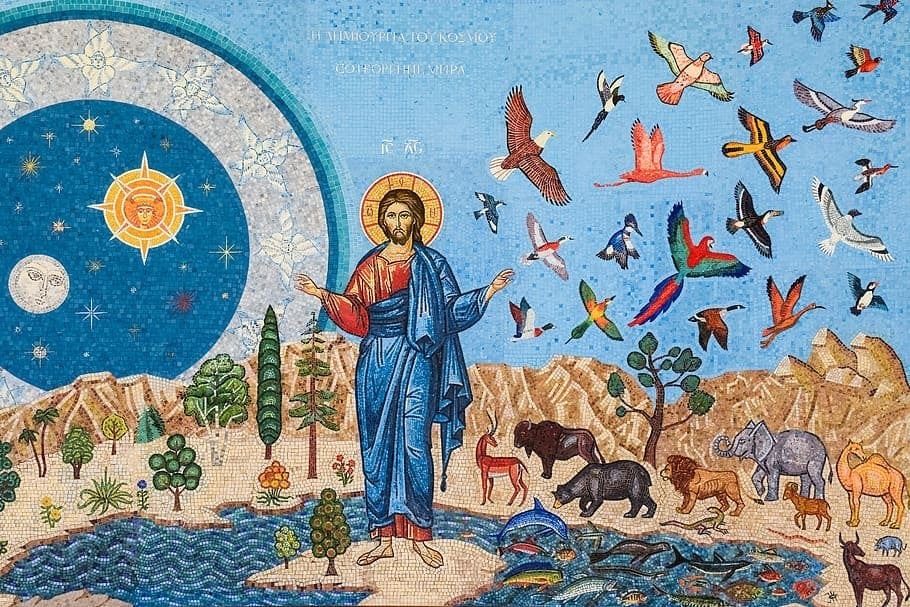
Answers to common objections:
Many Catholics today believe they can reconcile faith in God with belief in evolution, thinking that as long as they accept God as Creator, the details of how creation occurred are unimportant. However, this position overlooks the serious theological consequences of accepting evolutionary theory. Evolution, particularly Darwinian evolution, claims that all life forms, including man, arose from a process driven by random mutation and natural selection over millions of years. This view directly contradicts the Catholic understanding of a purposeful, ordered creation by God. More seriously, it undermines the doctrine of Original Sin by eliminating the historical Adam and Eve, whose fall from grace is the foundation of our need for salvation through Christ. If death existed for millions of years before man, then death is not the punishment for sin, and St. Paul’s words in Romans 5:12 - that death entered the world through one man - become meaningless.
Evolution also denies the uniqueness and dignity of man by reducing him to a product of animal ancestry. This has deeply affected modern culture, contributing to the rise of secularism and moral relativism. As belief in the historical truth of Genesis fades, so too does belief in doctrines rooted in it, such as the sanctity of marriage, the immorality of contraception, and the necessity of redemption. The Catechism of the Catholic Church (CCC 282) emphasizes that creation is not a peripheral issue but foundational to the Christian worldview. It teaches that catechesis on creation is of “major importance” because it addresses the most basic human questions: Where do we come from? Why are we here? Where are we going?
Some argue that the Church no longer takes Genesis literally, but this is incorrect. CCC 116 affirms that “the literal sense is the meaning conveyed by the words of Scripture,” and all other interpretations are based on that literal sense. St. Augustine, often misunderstood on this point, insisted that Scripture should be read literally unless a compelling reason exists to interpret it otherwise. Furthermore, Our Lord Himself affirmed the historical truth of Genesis in Matthew 19:4–6, when He based the doctrine of the indissolubility of marriage on the literal creation of Adam and Eve. St. Paul also appealed to the historical order of their creation in 1 Timothy 2:13 and 1 Corinthians 11:8, showing that theology is drawn from historical events. The Church’s liturgical practices affirm this understanding as well, for example, the Ash Wednesday phrase “Remember that you are dust, and to dust you shall return” only makes sense if Adam truly was created from the dust of the earth.
It is also important to distinguish between empirical science, which is based on direct observation and repeatable experiments, and historical science, which deals with past events that cannot be directly observed. Evolution falls into the latter category. It is not a “proven fact” but an interpretation of past events based on certain assumptions. Unfortunately, our educational system presents evolution as undeniable truth while ignoring or mocking alternative views such as creation. Scientists and educators who question evolution are often marginalized or punished, as shown in the documentary Expelled: No Intelligence Allowed. The same kind of cultural dogmatism applies to the issue of geocentrism. While many today reject the idea that Earth is at the center of the universe, it is worth remembering that Scripture consistently speaks of a stationary Earth and moving heavens (e.g., Psalm 104:5; Joshua 10:13). The geocentric model was never infallibly rejected by the Church and was embraced by virtually all Church Fathers. Modern cosmology, grounded in philosophical naturalism, dismisses this view not because it has been disproven but because it conflicts with a secular worldview.
Finally, some claim it doesn’t matter how God created the world, only that He did. But this too is mistaken. The how of creation carries theological meaning. For example, when Genesis says that Eve was created from Adam’s side, this is not just poetic imagery, it is a literal event with theological consequences. Jesus references this in Matthew 19 to explain marriage. Paul cites it to discuss male and female roles. These doctrinal teachings lose their foundation if Genesis is only myth. The Church has always taught that doctrine flows from real historical events, and Genesis is no exception. If Genesis is not real history, the foundation of Catholic teaching begins to erode. To preserve the integrity of the Faith, Catholics must return to a traditional understanding of creation, one that affirms the literal truth of Genesis, the special creation of man, and the ordered cosmos as revealed by God and supported by Sacred Tradition. Only then can we fully resist the secular errors that are drawing souls away from the Church.